Fixed dentures on implants:
All-on-4 and subperiosteal techniques
For patients with fully removable dentures, an edentulous jaw, or those at risk of losing their remaining teeth, there is a surgical treatment option in which a full fixed prosthesis is anchored to implants. Dr. Frank Vanhove is an oral and maxillofacial surgeon with over 20 years of experience in implantology and specializes in this type of treatment. If conventional implants (All-on-4, All-on-X) are no longer an option, subperiosteal implants may be considered.
All-on-4 treatments
Implants placed
Years of experience as an oral and maxillofacial surgeon
Who is a fixed full denture on implants suitable for?
Surgical replacement of an entire jaw using implants is an option for patients in any of the following situations:
You wear a fully removable denture
Removable dentures rest on the gums and can shift while eating or speaking. In cases of severe bone loss, the dentures become increasingly difficult to keep in place. A fixed prosthesis supported by implants offers a stable, functional replacement.
None of your remaining teeth can be treated
When the remaining teeth in a jaw can no longer be treated due to severe bone loss, periodontitis, or extensive damage, full replacement with implants may be considered.
Traditional implants are not an option
In cases of severe jawbone loss (atrophy), there is insufficient bone volume to anchor traditional root implants. In such cases, a subperiosteal jaw implant may be an alternative. After an examination, Dr. Vanhove will discuss which technique is feasible for your situation.
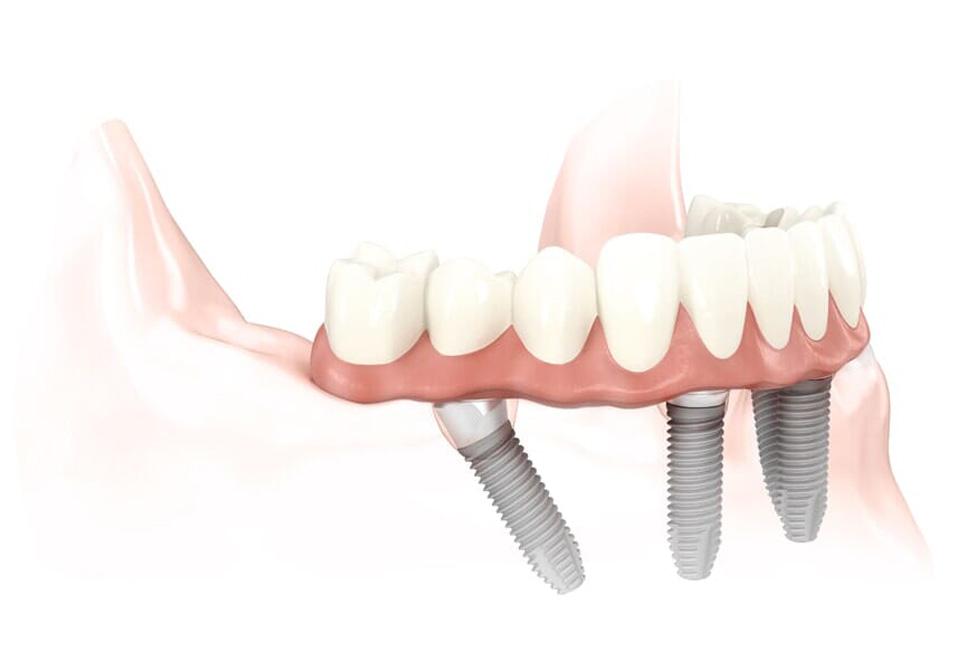
What is the All-on-4 treatment?
In the All-on-4 procedure, a full fixed denture consisting of 10 or 12 teeth is supported by 4 titanium implants placed in the jawbone. The two rear implants are positioned at an angle. This angled placement increases the distance between the support points, resulting in a more stable anchoring of the denture.
Because the implants are placed at an angle, the existing bone volume can be utilized in areas where more bone is present. In most cases, the existing jawbone is sufficient, and additional bone grafting is not required. Whether this is possible for a specific patient is determined following a 3D scan and clinical examination.
Immediate loading: fixed dentures on the day of the procedure
The All-on-4 treatment can be combined with immediate loading of the implants. This means that a temporary fixed prosthesis is placed on the day of the surgical procedure. After the procedure, the patient does not wear a removable temporary denture during the healing period.
Immediate loading is not applicable in every situation. Its feasibility is assessed on a case-by-case basis based on bone density, bone volume, and the primary stability of the implants after placement.
All-on-6 and other configurations
Depending on the anatomical situation and bone quality, the treatment team may opt for more than four abutments, for example, six implants (All-on-6). The principle remains the same: a full fixed prosthesis supported by a limited number of endosteal implants. The exact configuration is determined following the initial examinations.

Features
Surgical
- Implants are placed in the jawbone
- Angled placement of the posterior implants
- Suitable for use in the upper and lower jaws
- More than 250,000 patients treated worldwide
Functional
- Fixed denture, non-removable
- In most cases, bone grafting is not necessary
- A temporary prosthesis may be available on the day of the procedure
- Final prosthesis after approximately 3–4 months
When traditional implants aren't enough: subperiosteal dental implants
In patients with sufficient jawbone, traditional titanium implants can be placed directly into the bone. However, when the jawbone is severely atrophied—due to prolonged edentulism, bone disease, or other causes—there is insufficient volume to securely anchor root implants. In such cases, alternative surgical options are available.
A subperiosteal jaw implant is not drilled into the jawbone but placed on the bone surface, beneath the mucosa and the periosteum. The implant encases the jaw arch like a custom frame and is screwed into place where sufficient bone is present; in the upper jaw, this is typically next to the nasal bone and along the zygomatic bone, as these areas are less susceptible to further bone resorption.
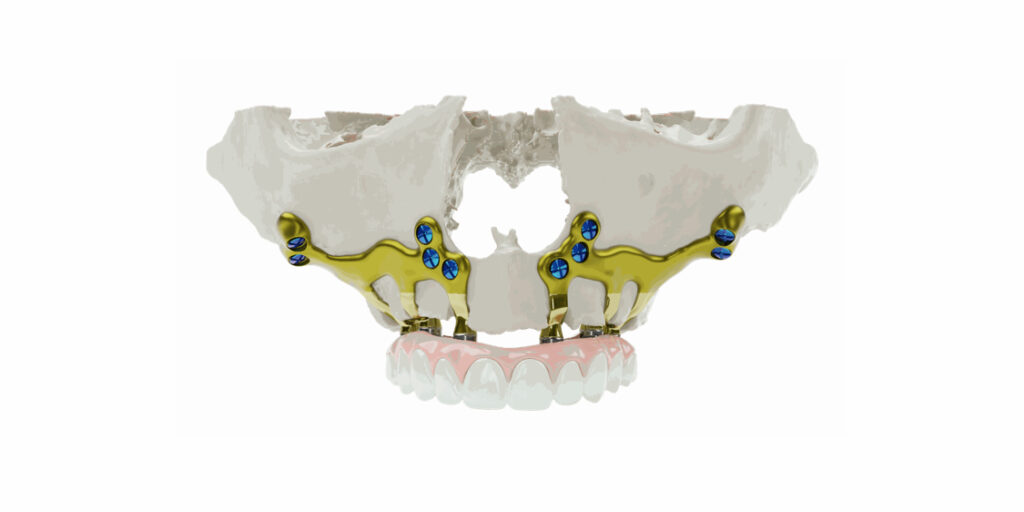
What is a subperiosteal dental implant?
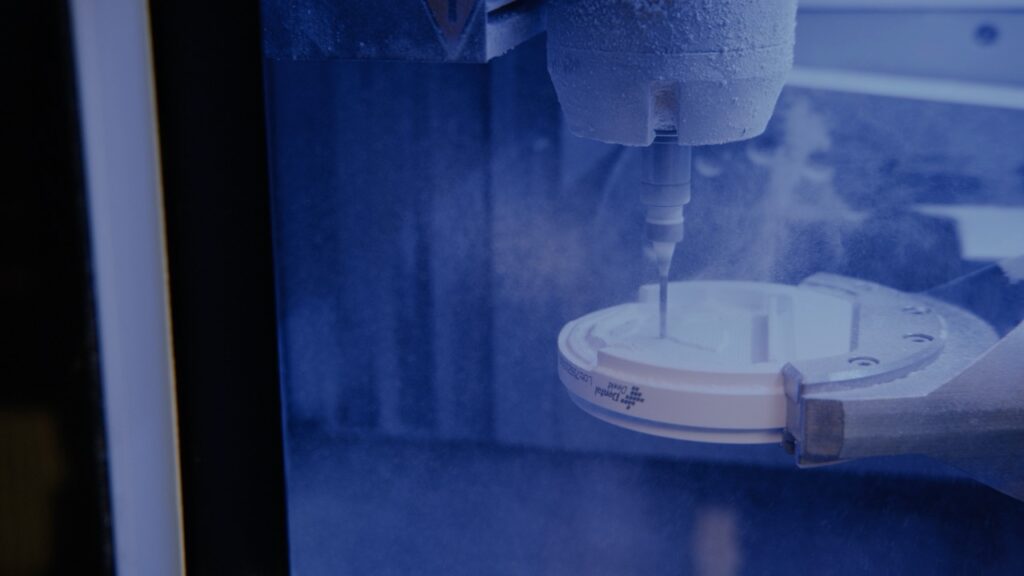
The implant is fully custom-made based on a CT scan of the patient’s jaw. Using digital planning software and 3D printing technology, a titanium frame is designed to fit the individual jaw structure precisely. Attached to this frame are connecting pins that pass through the gum tissue, to which a fixed prosthesis is secured.
The material used is medical-grade titanium (Ti6Al4V Grade 23 ELI), which is biocompatible and clinically validated. Each construction undergoes a validation process using finite element analysis to ensure mechanical strength.
When is a subperiosteal dental implant an option?
Determining whether a subperiosteal dental implant is suitable requires a detailed clinical and radiographic evaluation. The technique has been described as an alternative in cases of severe jawbone resorption, where conventional root implants would require extensive bone augmentation or are not feasible.
Clinical indications:
- Severe resorption of the upper or lower jaw with insufficient bone volume for endosteal implants
- Situations in which a bone grafting procedure is not advisable or not feasible
- Patients who, for medical reasons, cannot undergo multiple surgical procedures
- As an alternative to zygomatic implants in cases of maxillary bone resorption.
Limitations:
- This technique is only suitable for the complete replacement of a jaw, not for partial tooth replacement
- Eligibility is assessed on an individual basis for each patient following a CT scan and clinical examination


Comparison: conventional vs. subperiosteal implant
Dr. Vanhove will determine which technique is appropriate for your situation following a CBCT scan and a clinical examination.
Classic (All-on-4 / All-on-6)
If you wear removable dentures or if your teeth can no longer be saved but your jawbone is still intact.-
Suitable for
-
You wear removable dentures
-
Your remaining teeth can no longer be treated
-
There is still sufficient jawbone present
-
How does it work?
-
Consultation: 3D scan and personalized treatment plan
-
Day of the procedure: a temporary fixed prosthesis may be placed on day 1
-
After 3–4 months: permanent prosthesis, no further surgery
-
Frequently Asked Questions
-
Pain-free during the procedure under general anesthesia
-
This may cause temporary discomfort, which can be easily managed with pain medication
-
No removable temporary dentures during healing
-
Daily activities will resume within a few days
Subperiosteal implant
Titanium frame on the bone surface. When conventional implants are not an option or you have severe jawbone loss.-
Suitable for
-
There is insufficient jawbone for conventional implants
-
Bone grafting is not desirable or medically feasible
-
Multiple surgical procedures are not medically indicated
-
How does it work?
-
Consultation: CBCT scan; feasibility will be assessed
-
Custom manufacturing (a few weeks): 3D-printed titanium frame based on your jaw
-
Day of the procedure: fixed prosthesis fitted on day 1
-
After 3–4 months: permanent prosthesis, no further surgery
-
Frequently Asked Questions
-
Pain-free during the procedure under general anesthesia
-
This may cause temporary discomfort, which can be easily managed with pain medication
-
No bone grafting, a single surgical procedure
-
Fixed prosthesis fitted on the day of the procedure
How does the treatment work?
The treatment process consists of five steps, regardless of whether endosteal or subperiosteal implants are used. The timing for each step varies slightly depending on the technique chosen.
1. Personal consultation and 3D examination
During an initial consultation, Dr. Vanhove will discuss your situation. Following a 3D scan and clinical examination, we will determine which treatment option is right for you: traditional implants (All-on-4 or All-on-6) or subperiosteal jaw implants. You will receive a written treatment plan with a transparent price quote.
2. Digital planning and manufacturing
For endosteal implants, the surgical placement guides are digitally planned. For subperiosteal implants, the CBCT scan data is used to custom-design and 3D-print the titanium frame. This production phase takes several weeks.
3. The surgical procedure
Under anesthesia, any remaining teeth are removed and the implants are placed. For endosteal implants with immediate loading, and for subperiosteal implants, a temporary fixed prosthesis is attached on the same day.
4. Permanent prosthesis
After a healing period of approximately 3–4 months, the final prosthesis is placed. Thanks to the digital design and fabrication process, adjustments to the shape and bite can be made with precision.
5. Follow-up care
Regular checkups and good oral hygiene are essential for the longevity of your dentures and implants. You can visit Dr. Vanhove’s team or your own dentist for this.

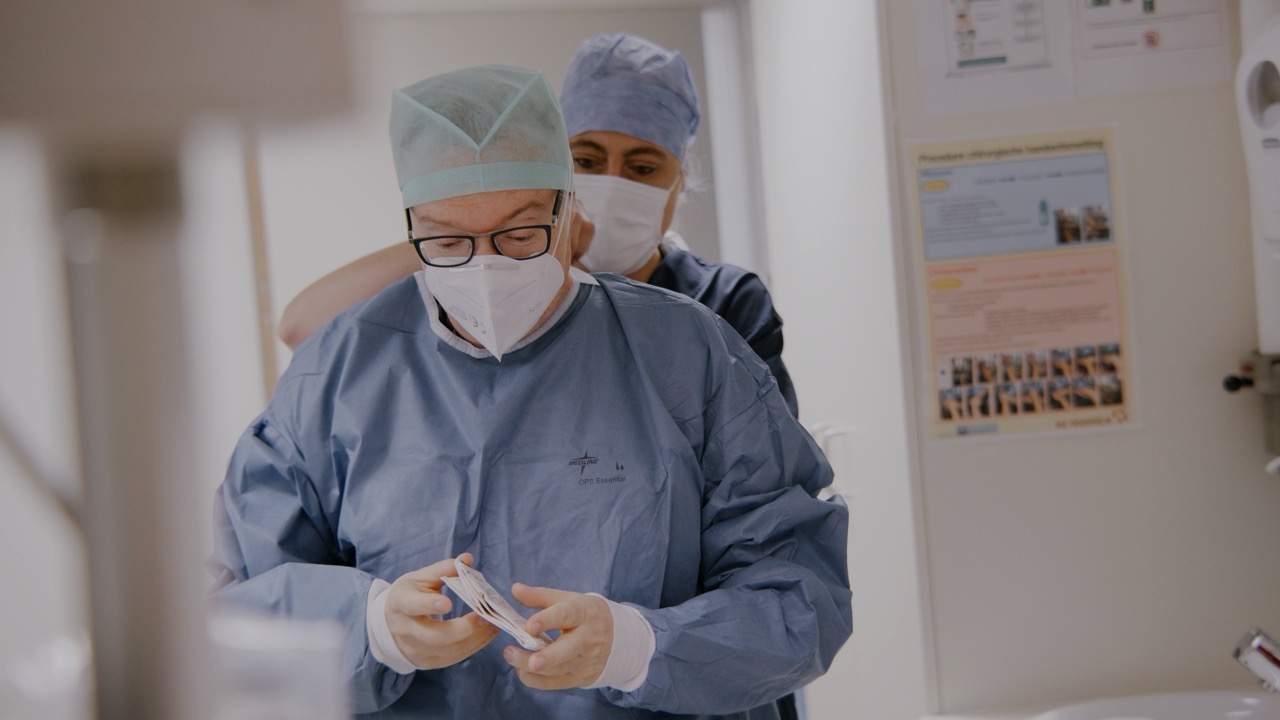
Your treatment by a certified specialist
Dr. Frank Vanhove is an oral and maxillofacial surgeon. He studied medicine at Ghent University (graduated in 1994, highest honors) and dentistry at the Vrije Universiteit Brussel (high honors, 1997). After receiving his certification as a specialist in stomatology (1999) and maxillofacial surgery (2001), he has focused on implantology since 2003.
As an oral and maxillofacial surgeon with expertise in both conventional and subperiosteal implants, he possesses the surgical skills required for complex oral and maxillofacial surgical situations. In addition to his clinical practice, he hosts the medical podcast Medical Soundbites, in which he discusses current topics in implantology and oral and maxillofacial surgery for clinicians and interested patients.
Education & Certifications
- Doctor of Medicine (Ghent University, 1994), Doctor of Dental Surgery (VUB, 1997)
- Board-certified specialist in stomatology (1999)
- Board-certified specialist in maxillofacial surgery (2001)
- Full-time faculty member at ZMACK Association (since 2016)
Practice
- Medical Director, Alto Dental Implant Clinic
- Co-founder, Millnau AG Digital Lab
- Practicing at AZ Monica, Deurne (Antwerp)
- Consultations at Alto Dental, Dorpstraat 22, Kapellen
Cost
The cost of treatment varies from patient to patient and depends on the chosen technique, the number of implants required, the condition of the jawbone, and the type of prosthesis.
Following the initial examination (a CT scan and a personal consultation), you will receive a written treatment plan with a transparent, detailed price quote.
Frequently Asked Questions
Is the procedure painful?
The procedure is performed under anesthesia, so you will not feel any pain during the operation. Some swelling and a nagging sensation are normal after the procedure. This discomfort is usually well managed with the pain medication prescribed by your surgeon. Discoloration of the face (bruising) is possible. Most patients resume their daily activities within a few days. If you experience severe pain, persistent swelling, or a fever, contact your surgeon immediately.
How long does the treatment take in total?
The entire process, from the initial consultation to the final prosthesis, takes an average of four to five months, depending on the technique chosen. For subperiosteal implants, the production time for the custom-made frame must also be factored in (usually a few weeks). Your surgeon will provide a realistic timeline after the initial examination.
Am I eligible?
This treatment is an option for patients who are completely edentulous in the upper or lower jaw, or whose remaining teeth in a jaw can no longer be treated. Whether you are eligible for conventional or subperiosteal implants, and which technique is right for your situation, will be assessed on the basis of a CT scan and a clinical examination.
What is the difference between removable dentures and implant-supported dentures?
Removable dentures rest on the gums and can come loose when eating or speaking. They also exert pressure on the gums and the underlying bone, which can accelerate bone resorption. A fixed prosthesis on implants is anchored in or onto the jawbone. It does not move, requires no adhesives and does not need to be removed at night.
How long will the prosthesis last?
Titanium implants are designed for long-term use and, with good oral hygiene and regular check-ups, can last for many years. The prosthesis itself (the bridge on the implants) may show signs of wear after 10 to 15 years and may need replacing. The actual lifespan depends on the materials used and individual circumstances.
What can I eat after the procedure?
In the weeks following the procedure, a soft diet is recommended to allow the implants and surrounding tissue to heal properly. Your surgeon will provide specific dietary advice after the procedure. Once the final prosthesis has been fitted, there are generally no long-term dietary restrictions.
I smoke. Does that make a difference?
Smoking increases the risk of complications with any implant treatment and slows down the healing process. This applies to both endosteal and subperiosteal implants. Dr Vanhove will discuss this during your consultation and inform you about the specific risks in your situation.
Who are subperiosteal dental implants suitable for?
Subperiosteal dental implants are considered when the jawbone has atrophied to such an extent that conventional root implants cannot be securely anchored. The implant is not drilled into the jawbone but placed on the bone surface, in areas where, despite the atrophy, there is still sufficient bone present. Whether this technique is suitable for you will be assessed following a detailed CT scan and clinical examination.
What is the difference between a subperiosteal implant and a bone graft?
In a bone augmentation procedure, the jawbone is built up using a bone graft or synthetic material, after which conventional implants can be placed following a healing period of several months. A subperiosteal jaw implant utilises the existing bone (even if there is little of it) and does not require bone augmentation. This can reduce the number of surgical procedures and the overall treatment time. Your surgeon will assess which approach is feasible and appropriate for your situation following an examination.
Would you like more information?
Dr Vanhove and his team will discuss your situation during a face-to-face consultation, based on a CT scan and a clinical examination. You will receive a written treatment plan, including the most suitable technique for your situation and a transparent quote.


